

Breed standards — FCI & AKC
A breed standard is a written description of the ideal dog of a breed, kept by a kennel organisation. Two are summarised here: the FCI standard No. 183 and the AKC Official Standard of the Miniature Schnauzer.
Een educatieve samenvatting van Atlas. Het is niet beoordeeld of goedgekeurd door de FCI of de AKC, en het is geen officiële vertaling.
Deze pagina is beschikbaar in het Engels en Servisch. De Engelse versie wordt getoond.
What a standard is — and is not
A standard describes an ideal for judging conformation at shows. It uses its own vocabulary: faults, serious faults and disqualifications are classes of deviation, and different organisations classify them differently.
A standard is not a law, and it is not the rule of every show: countries, clubs and events add their own conditions. A dog that does not meet the show standard is not for that reason "not a real Miniature Schnauzer", and being allowed to be registered is a separate question from being allowed in the show ring.
FCI, AKC of vergelijking
Choose FCI, AKC or the comparison. Without JavaScript all three are shown one after another.
FCI Standard No. 183
- Name
- Zwergschnauzer (Miniature Schnauzer)
- Country of origin
- Germany
- Classification
- Group 2 (Pinscher and Schnauzer — Molossoid breeds — Swiss Mountain and Cattle Dogs), Section 1 (Pinscher and Schnauzer type); without working trial
- Utilisation
- House and companion dog
- Document
- English version 18.04.2007; official valid standard published 06.03.2007; translation by Mrs C. Seidler; official language German
- Faults are graded as
- faults, serious faults and disqualifying faults
Proportions and size
- Height at the withers 30–35 cm; approximately 4–8 kg.
- Square build: height at the withers nearly equal to the body length.
- The head, from nose tip to occiput, is half the length of the topline (withers to tail set).
- Over- or undersize up to 1 cm is a fault; 1–2 cm a serious fault; more than 2 cm disqualifying. "Clumsy or light build" and "too low or too high on leg" are serious faults.
Head, eyes and ears
- Skull strong and long, without a markedly protruding occiput; flat, wrinkle-free forehead parallel to the bridge of the nose; stop well defined because of the brows.
- Muzzle ending in a blunt wedge, straight bridge; nose always black; lips black and tight.
- Eyes medium sized, oval, forward-facing, dark, lively.
- Drop ears, set high, V-shaped, inner edges close to the cheeks, turned forward towards the temples; folds parallel and not above the top of the skull.
Teeth and bite
- "The complete scissor bite (42 pure white teeth)", strongly developed and firmly closing.
- Pincer bite is a fault; a faulty mouth such as over- or undershot or wry mouth is a disqualifying fault.
Body and tail
- Topline slightly sloping from the withers; withers the highest point; back strong, short and taut; loins short, strong and deep; croup slightly rounded; chest moderately broad, oval, reaching the elbows.
- Tail: "Natural; a sabre or sickle carriage is sought after."
Coat
- Wiry, harsh and dense, with a dense undercoat; short on forehead and ears; the beard not too soft and the eyebrows bushy.
Movement
- Flexible, elegant, agile, free and ground covering; forelegs reaching as far forward as possible and hind legs providing drive; the front leg of one side and the hind leg of the other side move forward together. Pacing movement is a fault.
Temperament
- Intelligence, fearlessness, endurance and alertness; aggressive or overly shy dogs are disqualified.
AKC Official Standard
- Name
- Official Standard of the Miniature Schnauzer
- Group
- Terrier Group (the standard calls the breed "of terrier type")
- Document
- Approved July 10, 2012; effective September 4, 2012
- Faults are graded as
- faults (named inside each section) and disqualifications
- Weight
- the standard gives none
Proportions and size
- 12 to 14 inches; "sturdily built, nearly square", with plenty of bone and "without any suggestion of toyishness".
- The overall length from chest to buttock appears to equal the height at the withers.
- Under 12 or over 14 inches is a disqualification. Toyishness, ranginess or coarseness are faults of type.
- No weight is given in the standard.
Head, eyes and ears
- Head strong and rectangular, narrowing slightly from ears to eyes and again to the nose tip; forehead unwrinkled; top skull flat and fairly long; foreface parallel with a slight stop, at least as long as the top skull; muzzle strong, moderately blunt, with thick whiskers.
- Eyes small, dark brown, deep-set, oval, keen.
- Ears are described in two forms: cropped, with pointed tips, set high; or uncropped, small, V-shaped, folding close to the skull.
Teeth and bite
- Scissors bite: the upper front teeth overlap the lower ones so that the inner surface of the upper incisors barely touches the outer surface of the lower incisors when the mouth is closed.
- Undershot or overshot jaw and a level bite are faults.
Body and tail
- Body short and deep, brisket at least to the elbows, well-sprung ribs, short loin, straight backline declining slightly from the withers; withers the highest point.
- Tail set high and carried erect, "docked only long enough to be clearly visible over the backline"; a docked tail is described as that of a "properly presented" dog and others "should be severely penalized".
Coat
- Double coat, hard and wiry over a close undercoat; head, neck, ears, chest, tail and body coat "must be plucked"; furnishings fairly thick but not silky.
Movement
- Movement is judged at the trot; the forelegs have good reach and the hind legs strong drive. Single tracking, sidegaiting, paddling in front, hackney action and weak rear action are faults.
Temperament
- Alert and spirited, yet obedient to command; friendly, intelligent, willing to please; never overaggressive or timid.
Key differences
The rows show what each document says; a dash means the document does not say it. They are not "better" or "worse" — they are two descriptions with different vocabulary.
- binnen het bereik van de standaard
- fout (FCI: tot 1 cm buiten het bereik)
- ernstige fout (FCI: meer dan 1 cm maar minder dan 2 cm)
- diskwalificatie (FCI: meer dan 2 cm; AKC: buiten 12–14 inch)
| Topic | FCI No. 183 | AKC standard |
|---|---|---|
| Height at the withers | 30–35 cm | 12–14 inches (30.48–35.56 cm) |
| Size outside the range | Over- or undersize up to 1 cm: fault. More than 1 cm but less than 2 cm: serious fault. More than 2 cm: disqualifying fault. | Under 12 or over 14 inches: disqualification. |
| Weight | Approximately 4 to 8 kg | Not in the standard. (AKC's general breed weight chart, not part of the standard, lists 11–20 pounds, about 5.0–9.1 kg.) |
| Proportions | Square build: height at the withers nearly equal to the body length. Head length (nose tip to occiput) equals half the length of the topline (withers to tail set). | "Nearly square" in body length to height; overall length from chest to buttock appears to equal the height at the withers. |
| Eyes | Medium sized, oval, facing forward, dark, lively expression. Faults: light, too large or round. | Small, dark brown, deep-set, oval, keen. Faults: light and/or large and prominent. |
| Ears | Drop ears, set high, V-shaped, inner edges close to the cheeks, evenly carried, turned forward towards the temples. | Describes both: cropped (identical in shape and length, pointed tips, set high, carried perpendicularly at the inner edges) and uncropped (small, V-shaped, folding close to the skull). |
| Bite | Complete scissor bite, 42 teeth. Pincer bite: fault. Faulty mouth such as over- or undershot or wry mouth: disqualifying fault. | Scissors bite. Faults: undershot or overshot jaw, level bite. |
| Tail | "Natural; a sabre or sickle carriage is sought after." Fault: tail set inclined towards the head. | Set high and carried erect. Docked "only long enough to be clearly visible over the backline"; "all others should be severely penalized". Fault: tail set too low. |
| Coat | Wiry, harsh, dense; dense undercoat and a not too short top coat. Faults include too short, too long, soft, wavy, shaggy or silky coat. | Double: hard, wiry outer coat and close undercoat; head, neck, ears, chest, tail and body coat "must be plucked". Faults: coat too soft or too smooth and slick. |
| Colours | Four: pure black with black undercoat; pepper and salt; black/silver; pure white with white undercoat. | Three: salt and pepper, black and silver, solid black. Any other colour is a disqualification. |
| Nose | Always black. | Solid black; any other colour is a disqualification. |
| Movement | Flexible, elegant, agile, free and ground covering. Fault: pacing movement. | The trot is the gait at which movement is judged. Faults: single tracking, sidegaiting, paddling in front, hackney action, weak rear action. |
| Temperament | Intelligence, fearlessness, endurance, alertness. Aggressive or overly shy dogs: disqualifying fault. | Alert and spirited, yet obedient; friendly, intelligent, willing to please; never overaggressive or timid. |
| Note on breeding | N.B.: only functionally and clinically healthy dogs with breed-typical conformation should be used for breeding; males should have two apparently normal, fully descended testicles. | — |
Ears and tail: what each document says
The FCI text describes natural drop ears and a natural tail ("a sabre or sickle carriage is sought after"). The AKC text describes cropped and uncropped ears and a docked tail, and says that dogs without the docked tail it describes "should be severely penalized".
This is a description of the documents, not a recommendation. Atlas does not advise on cropping or docking. Whether such procedures are lawful, and what is accepted at a given show, depends on the country and the event.
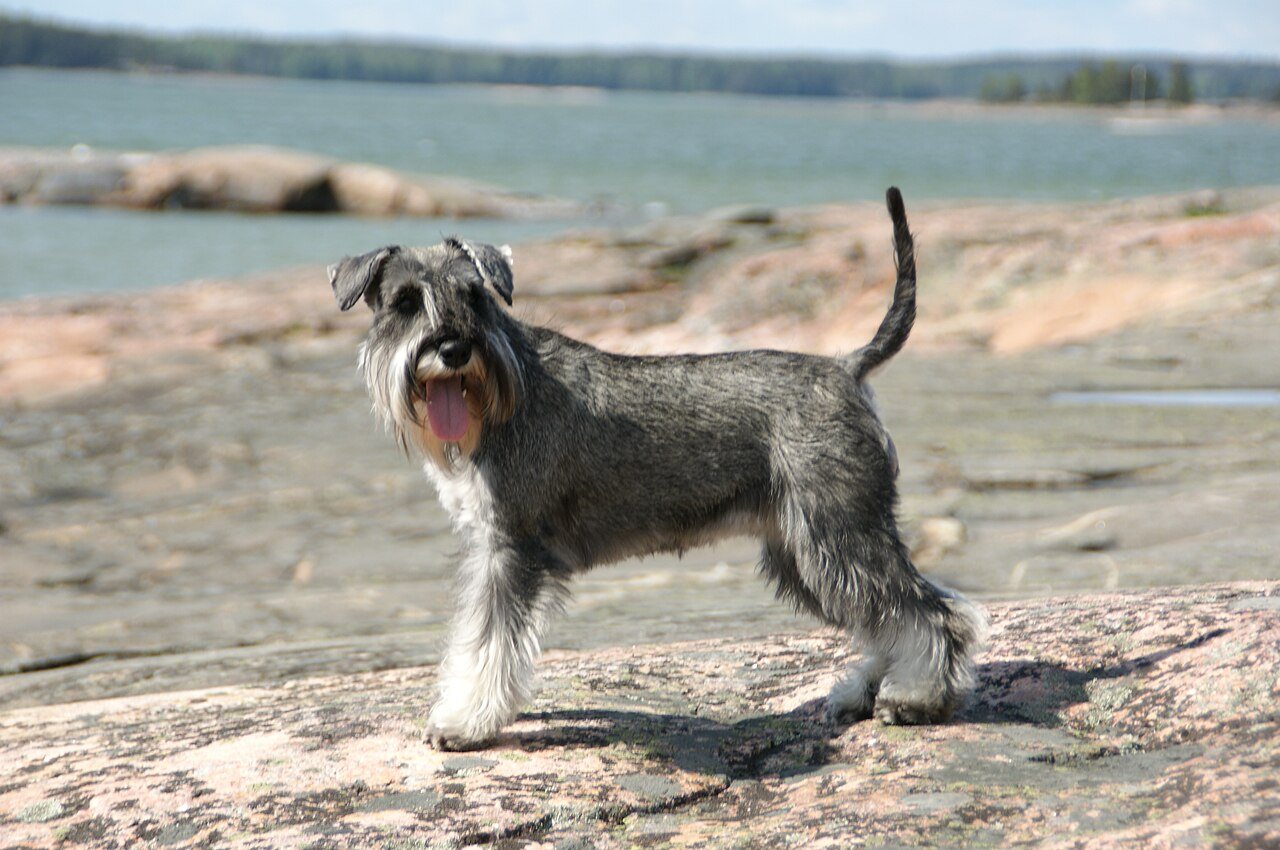
Pepper and salt Miniature Schnauzer in a pet clip, standing in profile outdoors, with natural drop ears and a natural tail carried upright — the ears and tail the FCI standard describes.
Canarian · CC BY-SA 3.0 · Wikimedia Commons
Bron en licentie van de foto
- Auteur
- Canarian · 2009-05-24
- Licentie
- CC BY-SA 3.0
- Hond
- The dog's name is not given in the source; no link to an Atlas profile.
- Wijzigingen
- Resized from the original (2288 × 1520 px) to 1280 px width and re-encoded as JPEG; also offered at 640 px; not cropped.
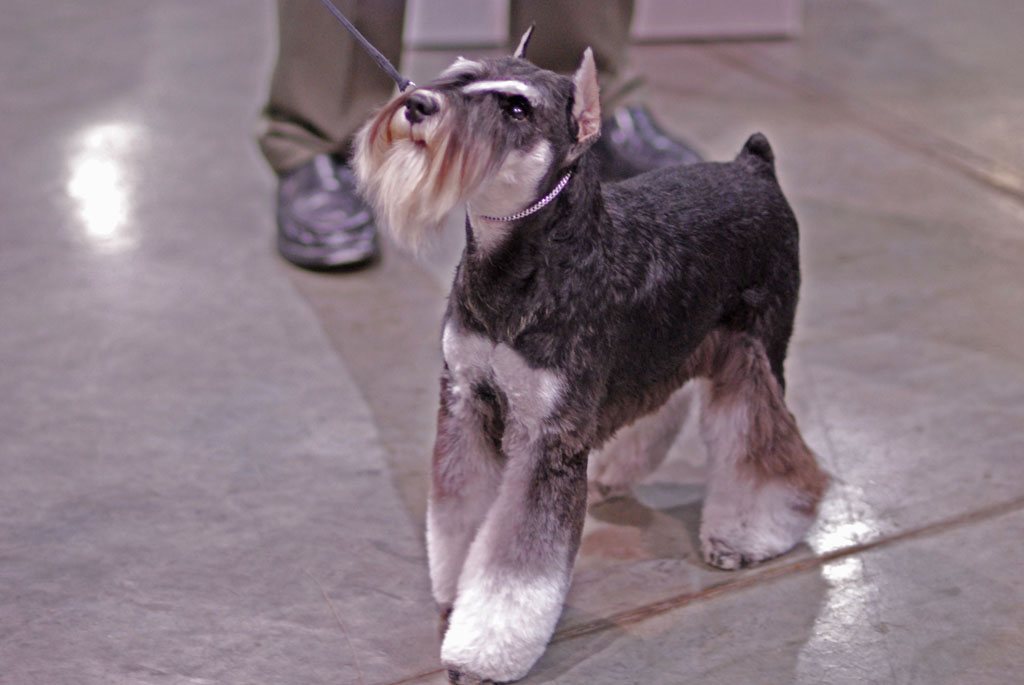
An AKC show example: a pepper and salt Miniature Schnauzer with cropped ears and a docked tail, the presentation the AKC standard describes. The FCI standard describes natural ears and a natural tail instead; neither picture is a recommendation.
SheltieBoy (Ron Armstrong) · CC BY 2.0 · Wikimedia Commons (from Flickr)
Bron en licentie van de foto
- Auteur
- SheltieBoy (Ron Armstrong) · 2007-01-22
- Licentie
- CC BY 2.0
- Hond
- The dog's name is not given in the source; no link to an Atlas profile.
- Wijzigingen
- Re-encoded as JPEG and also offered at 640 px width; not cropped. The colour cast of the original (indoor flash light) is left as it is.
Faults, serious faults and disqualifications
FCI: "any departure from the foregoing points should be considered a fault", in exact proportion to its degree and its effect upon the health and welfare of the dog. The standard then lists faults, serious faults and disqualifying faults (including aggressive or overly shy dogs, malformation of any kind, faulty mouth and size more than 2 cm outside the range).
AKC: faults are named inside each section; a separate list of disqualifications covers size outside 12–14 inches, a colour that is not allowed or white striping, patching or spotting on the coloured areas (apart from the small white chest spot allowed in black), and a nose of any colour other than solid black.
How to read this page
These are our own summaries in our own words; quotation marks mark wording taken from the documents. The Serbian text is an Atlas educational summary, not an official translation by FCI or AKC. For any decision, read the full documents linked below.
The FCI and AKC names and documents belong to their organisations. Atlas is not endorsed by or affiliated with them.
Bronnen en controledatums
Atlas is niet aangesloten bij of onderschreven door de FCI of de AKC. De namen en documenten zijn eigendom van deze organisaties.